
Vishnu Yella is a 3rd-year Neuroscience major studying medical comics, hospital leisure activities, and public health with Dr. Leah Misemer
How long have you been an undergraduate researcher at Georgia Tech?
I have been a researcher at Georgia Tech for two years now. I joined Dr. Misemer’s during the spring of my first year with Dr. Leah Misemer’s Graphic Medicine VIP project which produces accessible, illustrated medical education materials for patients at Shepherd Center.
How did you get involved with undergraduate research?
In 12th grade, while shadowing at a local pulmonology clinic, I noticed many elderly patients struggling to understand their treatment instructions. As I spoke with more physicians and researched this topic further, I learned that poor health literacy is a widespread public health issue that contributes to treatment complications, billions of dollars in medication waste, and millions of preventable hospital visits each year. For my high school capstone project, I researched potential solutions to this issue and created educational brochures on proper inhaler usage technique, using clear visuals to make instructions easier to understand and remember. When I came to Georgia Tech, joining Dr. Misemer’s Graphic Medicine VIP was a natural next step, as I wanted to build on this experience and contribute to projects that leverage visual communication to improve patient understanding. I was particularly excited about the opportunity to reach broader, more diverse populations and research my public health interests in a more structured environment. After the VIP selection process, I had a chance to join this team in January 2024.
What are you working on?
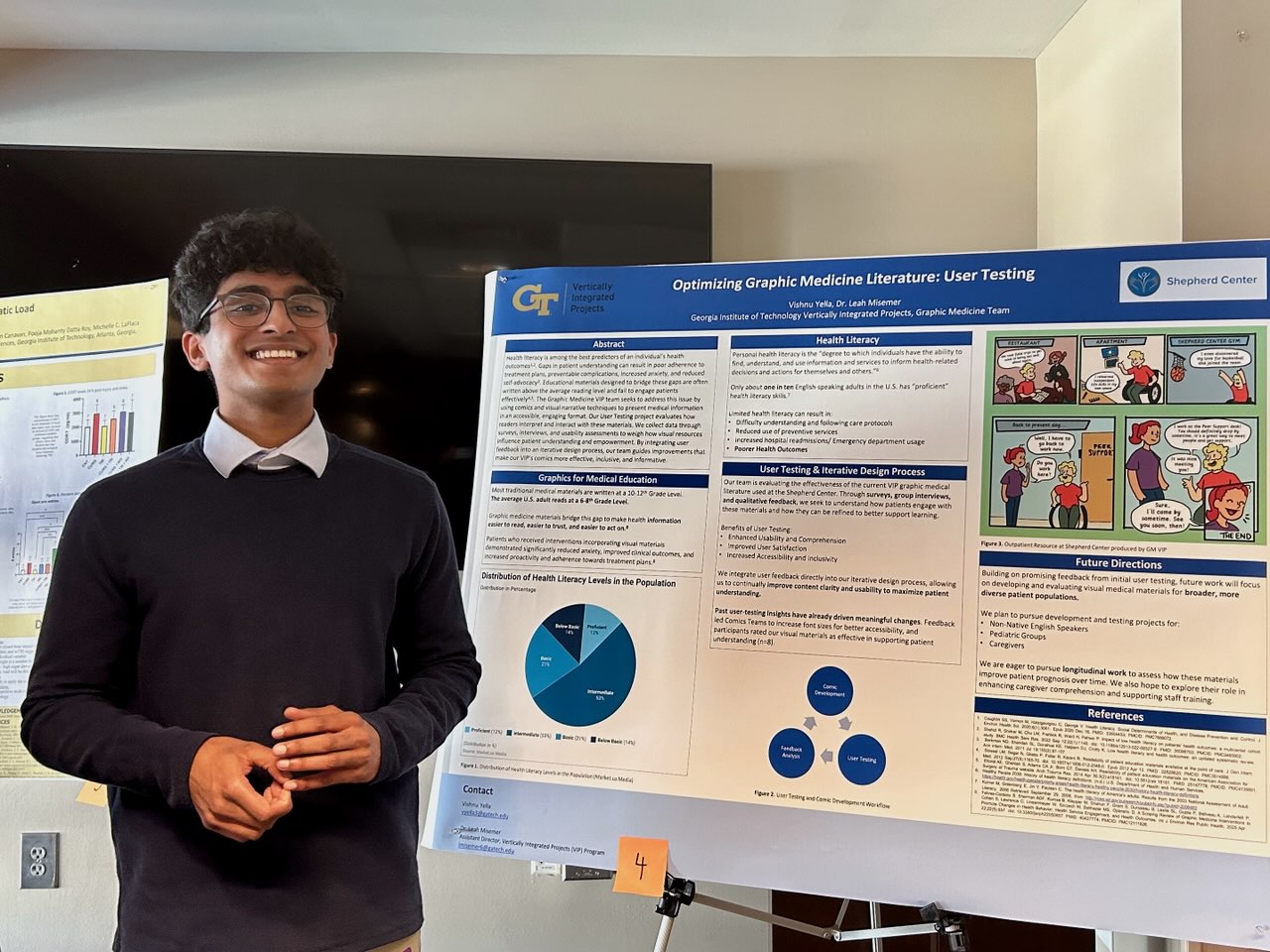
The Graphic Medicine VIP team translates medical information into an accessible, engaging format using comics and visual storytelling. I currently lead the User Testing project, where we evaluate how readers interpret and interact with these materials. My team collects qualitative and quantitative feedback to understand how visual resources shape patient comprehension and outcomes, then we incorporate those insights into an iterative design process to make our comics clearer, more inclusive, and more effective. Earlier this summer, with Dr. Misemer’s support, I launched an arts-based initiative to foster patient self-expression and engagement. This semester, we are integrating this programming into our user-testing workflows to expand data collection and strengthen patient engagement across Shepherd Center’s rehabilitation programs. This work has also shaped how I think about health literacy beyond patient education materials and into clinical outcomes. Outside of the Graphic Medicine VIP, I have also contributed to research projects that analyze the scope and impact of poor health literacy. Last year I collaborated with Dr. Corey Weinstein (Pediatric Urology) to evaluate 1,044 pediatric emergency presentations for testicular torsion over an eight-year period. Our findings suggested that lower parental health literacy was associated with a higher likelihood of more extensive surgical intervention and poorer clinical outcomes.
What is your favorite thing about research/researching?
My favorite part of research is seeing our team’s work come together into something real that reaches patients and community members. It keeps everything grounded in the larger goal to help patients. I am especially inspired by how past members of the Graphic Medicine VIP created graphic medicine materials that are still being used at Shepherd Center today. I hope to contribute work with that same kind of lasting impact.
What are your future plans and how has research influenced them?
I plan to pursue an MD/MPH so I can treat patients directly while also tackling the systemic issues that shape health. My projects with the Graphic Medicine VIP have taught me that research is often slow and unpredictable, but persistence and creativity can produce meaningful change. Looking ahead, I want to keep working on health literacy–focused projects that improve patient understanding and empower people to take a more active role in their health.
What advice do you have for students who want to be undergraduate researchers?
Finding and participating in research you are genuinely passionate about is far more valuable than joining a project to fill space on your résumé. Because finding research early can feel like a necessity, especially for pre-medical students, I think it is easy to jump into any available project without really thinking whether it is a good fit or not. Although it may take more time and effort to find a project that aligns with your interests, this extra step is definitely worth it. If you are unsure where your passions are, I strongly encourage taking full advantage of Georgia Tech’s resources and spending time exploring research areas online. When your research aligns with your interests and long-term goals, you are more likely to stay curious, put in extra effort, and grow meaningfully from the experience. Undergraduate research at Georgia Tech offers a unique opportunity to explore many disciplines at the forefront of their fields. Taking the time to find the right fit can make that experience that much more impactful and fulfilling.