
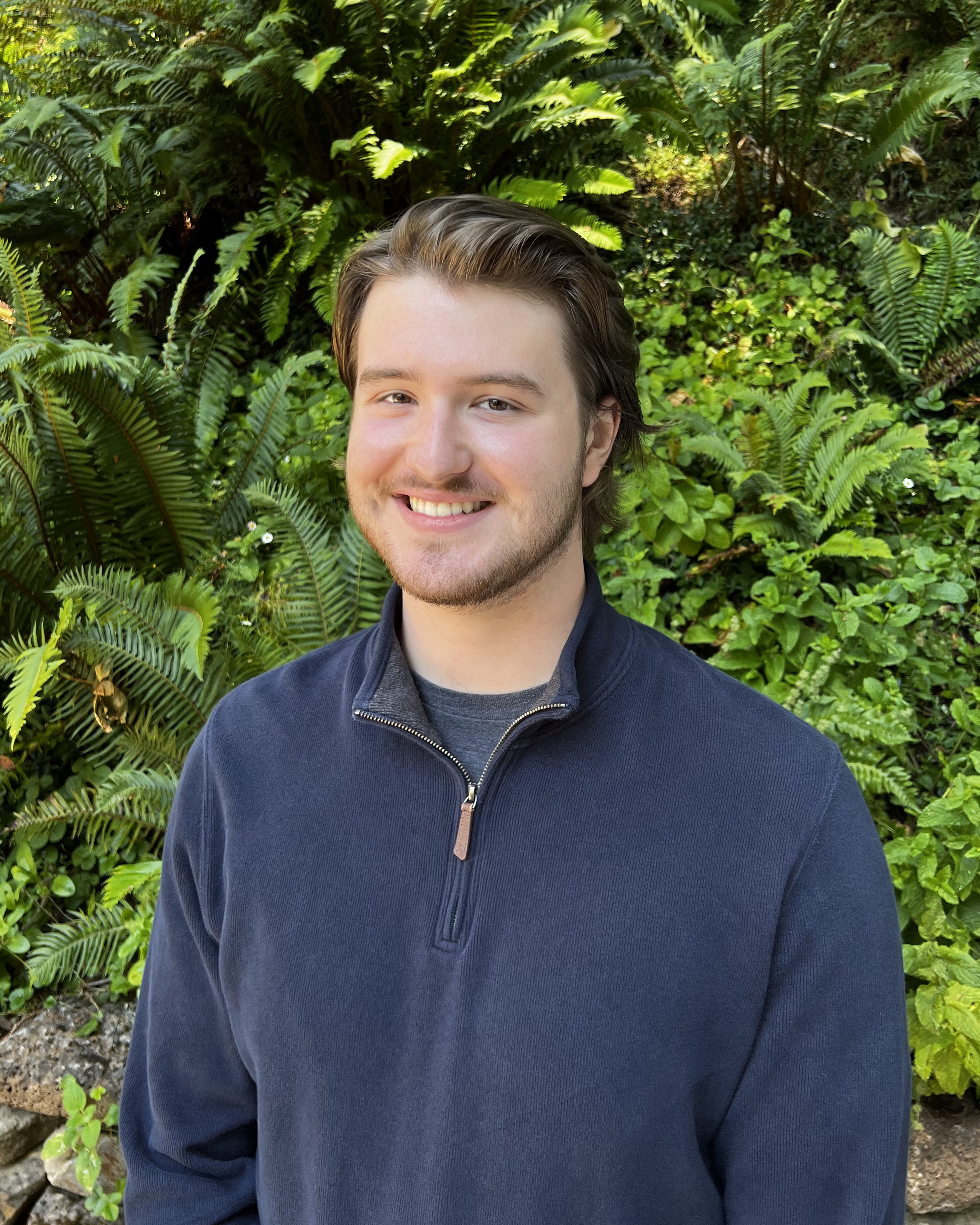
Eli Tarr is a 4th-year Computer Science major studying quantum computing with Dr. Moinuddin Qureshi.
How long have you been an undergraduate researcher at Georgia Tech?
This is my third semester officially doing research as an undergraduate at Tech, although I worked on other projects unofficially as well for multiple semesters. I’m currently working with Narges Alavisamani in the FAST lab (Future Architectures and SysTems) to develop distributed quantum computing systems.
How did you get involved with undergraduate research?
During my second year I took a discrete math class with Prof. Gerandy Brito, and we had a final project which was a survey on a state-of-the-art vector search algorithm. During the project I enjoyed learning the structure of the algorithm and the ideas used to make it. After the course, Prof. Brito offered to supervise me to continue the project and so we could try to more rigorously explore the time complexity. I had some friends who also had positive experiences with research by that point, so I accepted, and I’ve enjoyed research more ever since!
What are you working on?
I’m currently working on a project to make quantum computing more scalable and practical. Modern quantum systems require thousands of physical qubits to reliably represent a single logical qubit, and scaling beyond a single device is a major challenge. My research focuses on distributed quantum computing, where multiple smaller quantum processors are connected via entanglement. In particular, I study how to efficiently use limited entanglement resources to perform operations like remote gates and error correction across devices. The goal is to make large-scale quantum computation feasible with realistic hardware constraints.
Alongside this, I’m also interested in how information propagates through complex systems. With Prof. Zongchen Chen, I’m currently studying ways to quantify how signals change or degrade as they move through a network, using tools that measure how much information “contracts” at each step. Understanding this can help us design more reliable and efficient systems for both quantum and classical settings.
What is your favorite thing about research/researching?
My favorite thing about research is that there is always something new to learn. Each paper and problem introduces unfamiliar ideas, techniques, or perspectives, which keeps the work constantly engaging. At the same time, I find it especially rewarding that my contributions can help others learn and build on that knowledge. Being part of that process of sharing and expanding on scientific understanding is what makes research so meaningful to me.
What are your future plans and how has research influenced them?
After I graduate from Georgia Tech, I will be starting as a PhD student in computer science at UCLA advised by Professor. Jason Cong. I hope to continue my research on distributed quantum computation throughout my time there, build a deeper understanding of quantum architectures, and collaborate with others. My undergraduate research experience played a huge role in shaping this path; it showed me how much I enjoy tackling open-ended problems and pushed me to pursue research as a long-term career
What advice do you have for students who want to be undergraduate researchers?
Don’t worry about knowing everything before you start, since no one does. The most important thing is to be curious and willing to engage with difficult material. Talk to professors, ask questions, and follow up on things that genuinely interest you. Research can feel overwhelming at first, but you’d be surprised at what you can discover over a semester with consistent effort.